
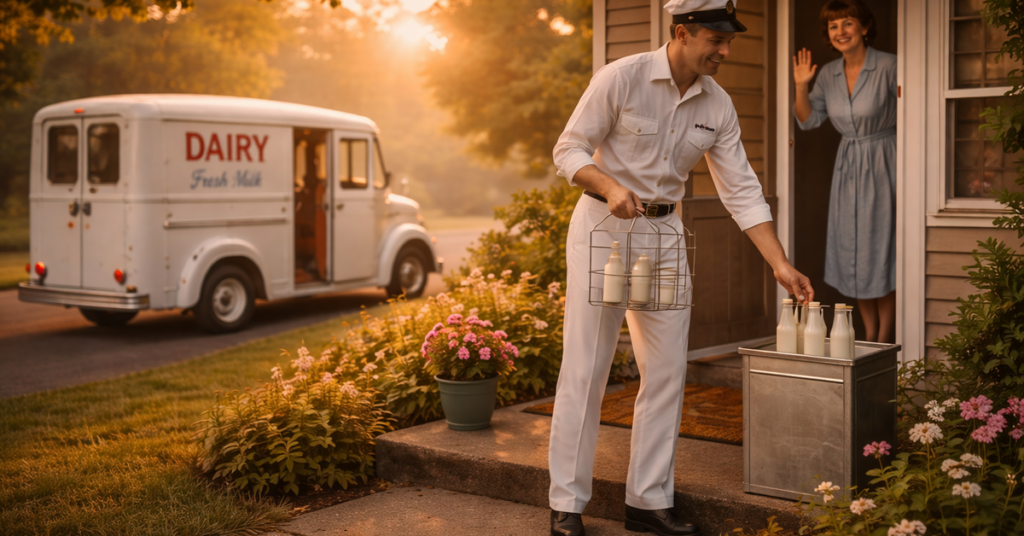
The sound started somewhere around 5 AM. Glass bottles clinking together in a metal carrier. The soft thud of footsteps on the front porch. Then the gentle rattle of the milk box lid opening and closing. Most days you slept right through it. But some mornings you caught that sound and smiled in your half-awake state. The milk man had come. Everything was right with the world.
He probably knew your family better than some of your relatives did. He knew when your mom had a new baby because the order doubled. He knew when someone was sick because she left a note asking for extra orange juice. He knew when company was coming because she requested that fancy glass bottle of chocolate milk. The milk man was a silent witness to the rhythm of your household. And somehow that felt completely normal.
More Than Just a Delivery
Your milk man had a name. Maybe it was Earl or Frank or Howard. Your mom knew it. She probably knew his wife’s name too. And the names of his kids. Because that’s how things worked back then. The people who provided services weren’t faceless employees of some corporation. They were neighbors. They were part of the community fabric.
He came to your house three times a week. Maybe Monday, Wednesday, and Friday. Or Tuesday, Thursday, and Saturday. The schedule was as reliable as the sunrise. You could set your watch by him if you woke up early enough. Rain or shine, summer heat or winter snow, he showed up. That kind of dependability meant something to families who were just trying to get by.
Your mom probably stood at the kitchen window sometimes and watched him work. She’d see him jump down from that white truck with the open sides. He’d grab the metal carrier and load it up with exactly what she ordered. Then he’d walk up the path like he owned the place. Because in a way he did. That path to your door was as much his territory as your own family’s.
The Magic of the Milk Box
Every house had one. That insulated metal box on the front porch or right next to the door. It wasn’t fancy. Just a simple container with a hinged lid. But it might as well have been a treasure chest.
On summer mornings you’d race outside in your pajamas to beat the heat. The milk needed to get inside before the sun warmed it up. You’d lift that lid and find the bottles standing there like soldiers at attention. Cold glass sweating in the morning air. The cream had risen to the top overnight and formed a thick yellow layer beneath the paper cap. That cream was liquid gold. Dad got first dibs for his coffee.
In winter the milk box performed a different kind of magic. Sometimes you’d find the milk bottles with frozen columns pushing up through the caps. The cream had expanded and created these funny little towers of frozen dairy. You’d bring them inside and watch them slowly thaw on the counter. It was like a science experiment happening right in your kitchen.
The empties went back in the box after your mom rinsed them out. She’d leave notes too. Written on scraps of paper and tucked under an empty bottle to keep them from blowing away. “Two extra quarts this week please. Having company.” Or “No cottage cheese until next Monday. Thank you!” The milk man always read those notes. And he always got the order right.
The Neighborhood Watchman
Here’s something people don’t talk about much. The milk man knew things. He saw things. He was out on those quiet streets when everyone else was still sleeping. If old Mrs. Patterson’s newspaper was still on her porch at 5:30 AM three days in a row he noticed. If a strange car was parked in front of the Henderson place all week he noticed that too.
Milk men saved lives. That’s not an exaggeration. They found people who had fallen and couldn’t get up. They noticed when a house fire started and called for help. They spotted broken windows that meant someone had broken in overnight. All because they walked the same route every single day and paid attention.
Your milk man probably knew which dogs to watch out for. He knew which gates stuck and which screen doors slammed loud enough to wake the baby. He knew that the Johnsons were early risers but the Wilsons wouldn’t be up until seven. This wasn’t surveillance. It was simply what happened when the same person visited your home a hundred and fifty times a year.
Those Crisp White Uniforms
The milk man looked professional. That mattered to people back then. He wore that white uniform with the company name stitched on the pocket. Maybe a bow tie or a neat cap to complete the look. His truck was clean and organized. The whole operation spoke of trustworthiness and competence.
Kids in the neighborhood thought he had the coolest job in the world. Driving that truck with no doors. Hopping in and out all morning long. Carrying those heavy crates like they weighed nothing. Some boys dreamed of growing up to be milk men just like other kids dreamed of being firefighters or astronauts.
The uniform meant he could walk up to any house on his route without raising suspicion. Neighbors looked out for each other in those days. A stranger approaching someone’s door at five in the morning would have caused concern. But the milk man in his whites? He belonged there. He was part of the scenery. Part of the deal.
The Products That Came to Your Door
It wasn’t just milk. Though that was the main attraction. Your milk man brought a whole dairy aisle right to your front porch.
There was whole milk in those tall glass bottles. The real stuff with the cream on top. Skim milk for anyone watching their weight. Buttermilk for baking. Your mom used it in pancakes and biscuits and that one cake recipe she made for church socials.
Butter came in neat little packages. Eggs arrived in cardboard cartons. Some routes offered cottage cheese and sour cream. Orange juice in thick glass bottles that weighed a ton but kept everything cold and fresh.
Around the holidays the milk man brought special treats. Eggnog thick enough to stand a spoon in. That only showed up in December and disappeared right after New Year’s Day. Chocolate milk was available year round but it felt like a special occasion every time your mom added it to the order.
The glass bottles gave everything a better taste. Or maybe that’s just how memory works. But milk from a glass bottle poured into a cold glass on a hot summer day tasted like nothing from a plastic jug ever could.
The Day the Milk Man Stopped Coming
It happened gradually. First the deliveries went from three times a week to two. Then down to once. Then your mom mentioned that maybe she’d just start picking up milk at the supermarket since she was there anyway.
The supermarkets made it too convenient. Too cheap. Plastic jugs cost less than glass bottles. The milk wasn’t quite as fresh but it was good enough. And good enough had a way of winning in the end.
One day you noticed the milk box was gone from the porch. Your dad had probably taken it down and put it in the garage. Nobody said anything about it. There was no ceremony. The milk man era just quietly ended like so many other things from that time.
The last milk man routes disappeared from most neighborhoods by the late 1970s or early 1980s. A few hung on in certain areas. But for most families the daily delivery became a memory. Another piece of childhood that faded into the stories we tell ourselves about how things used to be.
What We Lost Along the Way
The milk itself wasn’t irreplaceable. You can buy milk anywhere now. Better milk even. Organic milk and almond milk and oat milk and a dozen other varieties that nobody had heard of back then.
But the milk man represented something that’s harder to find today. He was a human connection built into the structure of daily life. A friendly face who showed up reliably and knew your family by name. A small piece of community that didn’t require any effort to maintain. It just existed because that’s how the world worked.
Your mom didn’t have to remember to pick up milk. She didn’t have to load kids in the car and fight for a parking spot. She didn’t have to stand in line behind someone with a cart full of groceries when all she needed was a gallon of milk. The milk just appeared. Like magic. Like something you could count on.
There was trust involved too. The milk man had a key to your milk box. He walked onto your property in the dark hours before dawn. Your family left money in an envelope and trusted him to make correct change. That kind of trust between strangers and families feels almost quaint now. But it was real. And it worked.
The clink of glass bottles at dawn. The cold weight of a full milk bottle in your hands. The cream waiting at the top for someone to shake it in or skim it off. These small sensory details created a feeling of home that’s hard to describe and impossible to recreate.
The milk man was never really about the milk. He was about a world that moved a little slower and felt a little more connected. A world where the same people showed up at your door week after week and year after year. A world where everyone knew everyone and that was just fine.