
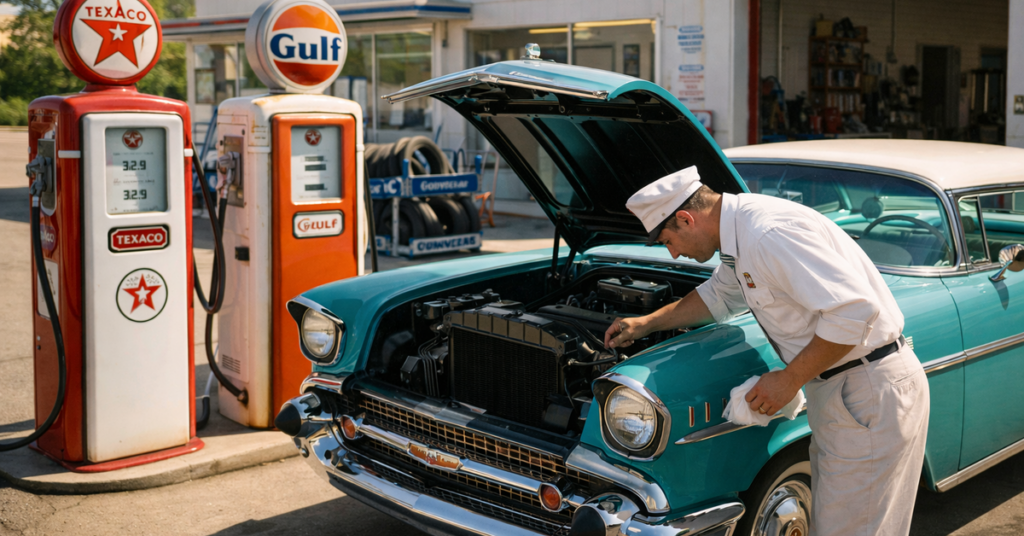
The bell rang out across the concrete as your tires rolled over that black rubber hose. Before you could even put the car in park, a young man in a crisp uniform was walking toward your window. He had a smile on his face and a rag in his back pocket. You didn’t have to get out of the car. You didn’t have to do anything except roll down your window and say those magical words: “Fill ‘er up with regular.”
That was the start of something that felt less like a transaction and more like a visit. The gas station of the 1950s and 1960s was a completely different animal than what we see today. It was a place where people knew your name. Where your windshield got cleaned whether you asked or not. Where a man in a bow tie might check your oil while asking about your kids.
Those stations weren’t just fuel stops. They were neighborhood fixtures. They were places that actually cared about earning your business.
The Art of Full Service
Pull into any gas station today and you’re greeted by a cold pump and a flickering screen asking if you want a car wash. Back then, you were greeted by a human being.
The attendant would appear at your window within seconds of that bell dinging. He was usually dressed in a matching shirt and pants. Maybe gray, maybe blue, often with his name embroidered on the chest. These weren’t sloppy uniforms either. These men took pride in how they looked. The station owner made sure of it.
“Fill ‘er up?” the attendant would ask. And while the gas was pumping, the real service began.
First came the windshield. That attendant would grab a squeegee and cleaning solution and work that glass until it sparkled. He’d get the back window too. Sometimes the side mirrors if you were at a station that really wanted your repeat business.
Then he’d pop your hood without asking. This wasn’t considered intrusive. It was expected. He’d check your oil level and show you the dipstick if it was getting low. He’d eyeball your belts and hoses. He’d check your radiator fluid. Some attendants would even look at your battery terminals and wipe them down if they looked corroded.
All of this happened while you sat comfortably in your car. Maybe you listened to the radio. Maybe you chatted with your kids in the back seat. You certainly didn’t stand outside in the rain or snow pumping your own gas.
And when everything was done, the attendant would tell you the total. You’d hand him cash or sometimes sign a charge slip. He’d say thank you like he meant it. And you’d drive away feeling like you’d been taken care of.
More Than Gas Under That Canopy
The services went far beyond filling your tank and checking your fluids. Many gas stations in the 1950s and 1960s were actually called service stations for good reason. They could fix just about anything that went wrong with your car.
Got a flat tire? The service station had you covered. Those guys would pull the tire off, patch the tube or plug the hole, and put everything back together. Some stations had hydraulic lifts and could do brake jobs. They’d rotate your tires. They’d replace your spark plugs and adjust your timing.
The mechanics at these stations knew their stuff. They learned by doing. They could diagnose a problem just by listening to your engine or watching how the exhaust looked. No computers. No fancy diagnostic machines. Just experience and know-how.
Many stations also offered towing services. If your car broke down on the highway, you could call the nearest service station and they’d send someone out with a tow truck. That same station would then fix whatever was wrong. It was a complete solution.
Some stations even rented out car trailers for when you needed to haul something big. Others sold tires right there on the premises. You could get a new set of Goodyears mounted and balanced without going anywhere else.
The point is that these places wanted to be your one-stop shop for anything car-related. They weren’t just selling gas. They were building relationships.
Those Friendly Freebies
Gas stations back then understood something that seems forgotten today. They knew that little extras created loyal customers. So they gave stuff away. Lots of stuff.
The road maps were probably the most useful freebie. Every major oil company printed beautiful folding maps of different states and regions. You could walk into any Esso station and grab a map of wherever you were headed. Planning a family vacation? Stop by your local station and pick up maps for every state along your route. Completely free.
These weren’t cheap maps either. They were printed on quality paper with clear markings and helpful information. Cities and towns were clearly labeled. Major attractions were noted. Some even had recommended routes for scenic drives.
Then there were the drinking glasses. Oh, the drinking glasses. Different stations ran different promotions. Fill up ten times and get a free glass with a cartoon character on it. Some sets featured state birds or historical figures. Families collected entire matching sets this way. Your mom probably still has some of those glasses in her cupboard.
Kids got the best stuff. Attendants kept little prizes behind the counter. Coloring books, balloons, lollipops, and small toys. A trip to the gas station with Dad meant coming home with a treat. It made the whole experience exciting for children.
Some stations gave out trading stamps. Green Stamps were probably the most famous. You’d get stamps based on how much gas you bought. Then you’d paste them into booklets and redeem them for merchandise from a catalog. Toasters, blenders, luggage. All earned by buying gas you were going to buy anyway.
These promotions worked because they made people feel special. You weren’t just a customer. You were appreciated.
The Station as Community Hub
In many small towns and suburban neighborhoods, the gas station served a purpose that went beyond cars entirely. It was a gathering spot. A place where folks would hang around and chat.
The owner usually knew everyone who came in. He knew their cars, their families, and their stories. When you pulled in for gas, you might end up talking for twenty minutes about the high school football team or how the weather was affecting the crops.
Many stations had little waiting areas inside. Just a few chairs and maybe a soda machine. But that was enough. Guys would stop by on Saturday mornings and shoot the breeze while getting their oil changed. The radio would be playing. Someone would tell a joke. Time seemed to move a little slower.
Teenagers often hung out at gas stations too. Not to cause trouble, but because it was somewhere to be. Maybe they’d help out around the station in exchange for a few bucks or some mechanical knowledge. Many young men learned everything they knew about cars from hanging around the local service station.
The station was also a source of help in emergencies. Car trouble on a dark road? The nearest gas station meant safety. Locked your keys in the car? The attendant probably had a slim jim and could help you out. Needed directions? These guys knew every road and shortcut within fifty miles.
There was a trust that existed between the station and its customers. You knew they wouldn’t cheat you. They knew you’d keep coming back. It was a relationship built on handshakes and follow-through.
The Architecture of Memory
You could often spot a gas station from blocks away, and each brand had its own distinctive look.
Texaco stations had that big red star mounted on a tall sign. The star would glow at night, guiding travelers like a beacon. The stations themselves were often white with clean lines and the signature green trim.
Phillips 66 had that orange and black shield. Their stations tended to be modern-looking for the era. The company wanted to project an image of progress and innovation.
Gulf stations featured that simple orange disc. It was impossible to miss. Many Gulf stations had those distinctive “ice cream scoop” architecture rooflines that looked almost futuristic.
And who could forget the flying red horse of Mobil? That Pegasus was one of the most recognized symbols in America. Kids would spot it from the highway and call it out.
Inside, many stations had tile floors that were scrubbed clean every day. The smell was a mixture of gasoline, motor oil, and whatever cleaning solution they used on the restrooms. Surprisingly, those restrooms were often immaculate. Oil companies actually sent inspectors around to check on station cleanliness. A dirty restroom could hurt a brand’s reputation.
Some stations had attached restaurants or diners. You could fill your tank and fill your belly all in one stop. These combination spots were especially popular along major highways where travelers needed both fuel and food.
The architecture mattered because it created memories. You remember what those stations looked like. The images are burned into your mind right alongside the feeling of summer road trips and the sound of gravel crunching under tires.
The Slow Fade to Self-Service
The change didn’t happen overnight. It crept in slowly during the 1970s.
The oil crisis of 1973 changed everything. Gas prices spiked. Lines formed at stations. Suddenly, every penny mattered. Station owners started looking for ways to cut costs. And the most obvious cost to cut was labor.
Self-service pumps began appearing. At first, they offered a small discount compared to full-service prices. Pay a little less if you pump it yourself. Many customers jumped at the savings.
By the late 1970s and into the 1980s, self-service had taken over. Full-service islands became rare. Then they became almost nonexistent. The attendants in crisp uniforms disappeared. The squeegees hung unused. The oil checks stopped.
The stations themselves changed too. Why have service bays when you can add more pumps? Why have mechanics when customers just want cheap gas? The neighborhood service station became the gas station mini-mart. The focus shifted from service to convenience snacks and lottery tickets.
New Jersey and Oregon still require full-service pumping by law. If you’ve ever filled up in one of those states, you’ve gotten a tiny taste of how things used to be everywhere. It feels strange at first. Then it feels like a small luxury.
What We Lost Along the Way
This isn’t about being angry at progress. Cars today are more reliable than ever. They don’t need someone checking the oil every week. Computerized diagnostics can spot problems we never knew existed.
But something valuable did disappear when those full-service stations faded away.
We lost that human connection. The simple pleasure of being recognized and served with care. The knowledge that someone was looking out for us and our vehicles. The conversation, the relationship, the trust.
We lost the ritual of it all. The drive to the station wasn’t just an errand. It was a small event. A moment to catch up with a neighbor. A chance for kids to get a lollipop and feel special.
Today we swipe cards at faceless pumps and never make eye contact with another human being. We’re in and out in five minutes. Efficient, yes. But also a little empty.
Those old service stations represented something about how communities used to function. People took care of each other. Businesses invested in relationships, not just transactions. Service meant something more than speed.
Every time you drive past a gas station, maybe think about what used to happen under canopies like that one. The uniformed attendants hustling from car to car. The ding of that bell. The genuine smile when someone said thank you.
Those memories are still there, tucked away somewhere between the price per gallon and the smell of gasoline. And they’re worth remembering.