
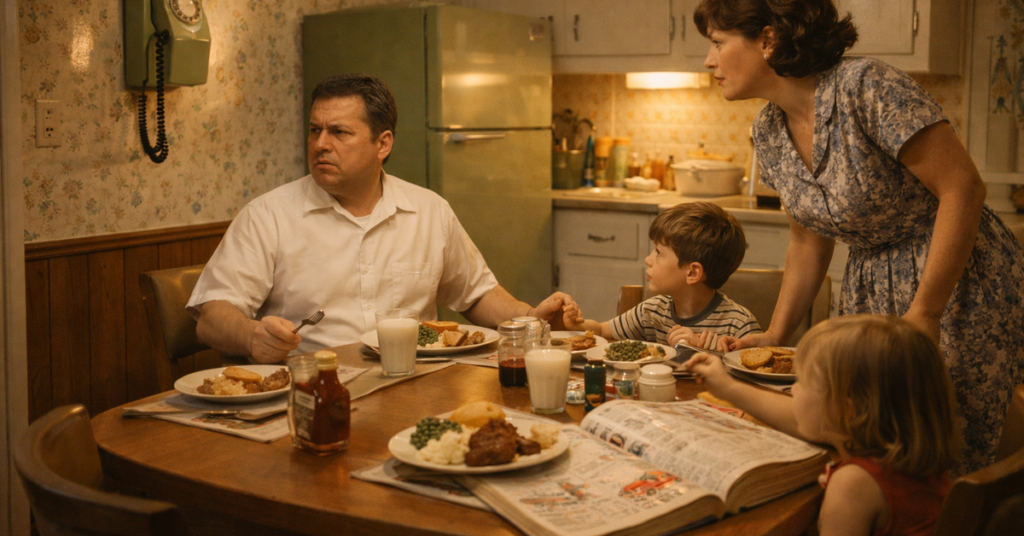
The meatloaf was steaming on the table. Dad had just said grace. Your fork was halfway to your mouth when that shrill ring cut through the kitchen like a fire alarm. Everyone froze. Eyes darted toward the wall phone. And in that split second, a family drama unfolded that kids today will never understand.
That ring meant something back then. It carried weight. Somebody took the time to dial your number, wait through the rings, and hope you were home. There was no caller ID. No voicemail. No way to know if it was Grandma calling about Sunday dinner or a wrong number from three towns over.
And when that phone rang during the sacred dinner hour? Well, that was a whole situation.
The Kitchen Wall Phone: Command Central
Every house had one. That phone mounted on the kitchen wall with the curly cord that stretched just far enough to let you duck around the corner for privacy. Maybe yours was harvest gold. Maybe avocado green. Maybe that classic black rotary that weighed about five pounds.
The phone had a permanent spot in the kitchen because that was the heart of the home. Mom could stir the pot roast and take a call at the same time. She could supervise homework at the table while chatting with Aunt Betty about the church bake sale. That phone cord wrapped around her like a dance partner as she moved from the stove to the fridge and back again.
Some families were fancy enough to have a second phone in the hallway or the master bedroom. But the kitchen phone was the main line. The one that rang loudest. The one everyone could hear no matter where they were in the house.
And when it rang during dinner, every ear perked up.
The Unwritten Rules of Dinnertime
In most households, dinner was not optional. It was not negotiable. And it was absolutely not to be interrupted.
Dad came home from work at five thirty. Mom had dinner on the table by six. Everyone sat in their assigned seats. You ate what was put in front of you. And you talked about your day like civilized people.
This was the one hour when the family was all together. No television. No radio. Just the clink of forks on plates and conversation about school and work and whether the Johnsons down the street were really getting a divorce.
So when that phone dared to ring in the middle of this ritual, it created a genuine crisis of etiquette.
Some families had a hard and fast rule. We do not answer the phone during dinner. Period. Let it ring. Whoever it is can call back. The family comes first.
Other families took a softer approach. Someone would get up and answer, but only to say “We’re eating dinner. I’ll call you back.” Click. Done. No conversation. No exceptions.
And then there were the families where someone actually took the call. Maybe it was the teenage daughter who leaped up before the first ring finished because she was waiting to hear from that cute boy in her history class. The eye rolls from Dad could be felt across the room.
The Scramble to Answer
Here’s something kids today will never experience. The mad dash to get to the phone before it stopped ringing.
You had maybe four rings. Maybe five if you were lucky. That phone was going to ring and ring, and then it was going to stop. And you would never know who called. There was no missed call log. No callback feature. That person was just gone into the void.
So when the phone rang during dinner, there was a moment of calculation. How important might this call be? Is anyone expecting a call? Who’s closest to the phone?
If you were the one to answer, you had about two seconds to convey the appropriate level of annoyance that someone was calling during dinner while also being polite enough not to offend whoever was on the other end. This was a delicate social dance.
“Hello? Oh, hi Mrs. Patterson. We’re just sitting down to dinner. Can Mom call you back in about an hour?”
The extended cord would stretch as you pressed the receiver to your shoulder and made meaningful eye contact with your mother. She would nod or shake her head or make some gesture that indicated whether this was an emergency worth abandoning the cooling pot roast.
Nine times out of ten, it was not.
When the Call Was Actually Important
But every once in a while, that dinnertime ring was the real deal.
Maybe it was Grandpa calling to say Grandma was in the hospital. Maybe it was Uncle Frank with news about the baby being born. Maybe it was the principal calling because your brother did something at school that required immediate parental attention.
You could always tell when it was serious. Mom’s face would change. Her voice would drop. She would turn away from the table and hunch over the phone like she was trying to create a little bubble of privacy in the open kitchen.
Everyone at the table would stop eating. Stop talking. Just watch Mom’s back and try to decode the conversation from her end of it.
“Uh huh. When did this happen? Is he okay? Which hospital?”
The mashed potatoes went cold. The green beans sat untouched. Because when a serious call came in during dinner, the whole meal was effectively over. Whatever news was coming through that phone line was about to become the only thing anyone could think about.
Those moments reminded everyone why we answered the phone in the first place. Before cell phones and instant communication, that landline was your lifeline to the outside world. You never knew when something important was coming through.
The Teenager’s Dilemma
If you were a teenager in the sixties or seventies, the dinner hour phone ring was particularly excruciating.
Your entire social life depended on that phone. Did Bobby ask his mom if he could go to the movies on Saturday? Was Jennifer going to tell you what happened with that boy at the football game? Did the cool kids decide if they were meeting at the drive in or the roller rink?
All of this crucial intelligence was being transmitted through phone calls. And if a call came in during dinner, you had to make a choice.
Do you let it ring and risk missing the most important call of your entire life? Or do you jump up and answer it, knowing full well that Dad is going to give you that look and Mom is going to remind you for the hundredth time that dinner is family time?
Some kids had an arrangement with their friends. Three rings and hang up, then call right back. That was the signal that it was a friend calling and not a salesman or your aunt from out of state. If you heard that pattern, you knew it was safe to pick up.
Of course, this system fell apart when your friend’s little brother decided to prank call you six times during dinner. Nothing like explaining to your father why the phone kept ringing and no one was there.
The Long Goodbye Problem
Even when the call was brief, getting off the phone was never simple.
You could not just hang up. That would be rude. You had to go through the proper phone etiquette of wrapping up the conversation. This involved at least three rounds of saying goodbye.
“Okay, well, I should let you go. Uh huh. Okay. Sounds good. I’ll tell her. Okay. Bye now. Yep. Talk to you later. Bye bye.”
Meanwhile, your family was sitting at the table watching their dinner get cold and wondering why you couldn’t just say goodbye once like a normal person.
But that was phone culture back then. You didn’t just end calls. You eased out of them. Like leaving a party. You had to make the rounds, say your goodbyes, promise to talk soon, and then finally make your exit.
All while your father pointed meaningfully at his watch.
The Night the Phone Didn’t Ring
Funny thing about those dinnertime interruptions. As much as everyone complained about them, there was something worse. The night the phone didn’t ring at all.
A silent phone meant nobody was thinking about you. No friends calling to chat. No relatives checking in. No news, good or bad, making its way to your kitchen.
A house without phone calls felt isolated. Cut off from the world. Like maybe everyone forgot you existed.
So we grumbled about the interruptions. We rolled our eyes when Grandma called right as the roast came out of the oven. We instituted rules and protocols and systems to manage the intrusion.
But deep down, we liked being wanted. We liked being connected. We liked knowing that at any moment, that phone might ring and bring some news, some gossip, some reminder that we mattered to somebody out there in the world.
A Different Kind of Connection
The kitchen phone is mostly gone now. That curly cord has been replaced by the rectangular glow of smartphones that never leave our pockets. Nobody races to answer before the fourth ring anymore. Nobody stretches a cord around the corner for privacy.
And nobody interrupts dinner quite the same way.
Today we can see who’s calling. We can send them to voicemail with a tap. We can text back “in the middle of dinner” without saying a word.
It’s more convenient. More efficient. More controlled.
But sometimes, on a quiet evening, you might find yourself missing that shrill ring that meant somebody wanted to talk to you right now. That moment of mystery before you picked up. That tiny adventure of not knowing who was on the other end.
The meatloaf was better when it was interrupted.