
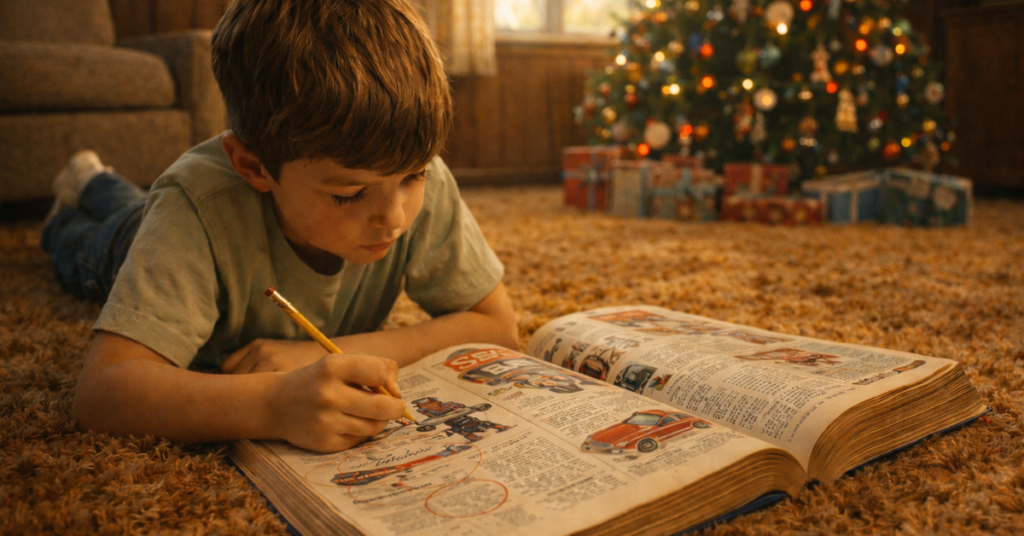
The thud of that massive catalog hitting the front porch could be heard from anywhere in the house. You knew exactly what that sound meant. Drop whatever you’re doing. The new Sears Wishbook has arrived.
That thick, glossy book wasn’t just a catalog. It was a portal to everything we wanted, needed, and dreamed about. In a world before Amazon Prime and overnight shipping, the Sears catalog connected us to thousands of products we’d never see in our small town stores. It was our search engine, our shopping cart, and our entertainment all wrapped in one hefty package.
The Arrival Was an Event
There was something almost magical about catalog day. The fall edition usually showed up in late August or early September. It landed on the porch with enough weight to qualify as exercise equipment. Some years, that book topped 1,500 pages and weighed close to five pounds.
Getting to it first was a competition in most households. Mom wanted to look at curtains and kitchen gadgets. Dad needed to check out the tools and auto parts. But kids? We made a beeline for the toy section like our lives depended on it.
The smell of those fresh-printed pages mixed with the glossy ink is something you never forget. You’d crack open that spine and breathe it in. Then you’d flip frantically to find page 287 or wherever the toys started that year. Heaven was right there in black, white, and full color.
The Toy Section Was Sacred Ground
Forget reading it from front to back like a normal person. The toy section required a completely different approach. You studied it. You memorized it. You visited those pages so many times the book naturally fell open to them.
Every bicycle on those pages looked like freedom. The banana seats, the high-rise handlebars, the streamers flowing from the grips. You could almost feel the wind in your hair just looking at the pictures. The Sting-Ray cost around $50 in the mid-1960s, which might as well have been a million dollars. But that didn’t stop you from dreaming.
The doll pages kept sisters occupied for hours. Barbie and all her friends lived in their own little world. The Dream House, the convertible, the endless outfits. Each tiny accessory cost extra, of course. Sears knew exactly what they were doing.
Boys circled the GI Joe section, the model car kits, and those elaborate electric train sets that took up entire basement floors. The Erector Sets promised you could build real working machines. The chemistry sets came with actual chemicals that would probably get companies sued today.
You’d take a pen or crayon and circle everything you wanted. Pages got dog-eared. Items got starred, underlined, and ranked in order of importance. That catalog became a working document of childhood desire.
Christmas Lists Started in September
The Wishbook earned its name because it transformed into a Christmas planning guide the moment school started. Parents dreaded those words: “Can I see the catalog?”
They knew what was coming. You’d haul that massive book into the living room and start the annual negotiation. Pointing at the Kenner Easy-Bake Oven on page 312. Explaining why you absolutely needed the complete Hot Wheels Super Charger set with the loop-the-loop track.
Smart parents gave each kid a budget. You had $25 worth of circling privileges, and that was it. This taught basic math, prioritization, and the crushing reality of economics. Did you want one big thing or several small things? These were serious decisions that required serious catalog consultation.
The lists we made were works of art. Some kids cut out the actual pictures and glued them to notebook paper. Others wrote detailed descriptions including page numbers and item codes. A few entrepreneurial types even included backup options in case their first choice sold out.
Mailing those lists to Santa meant including the Sears catalog page number. Santa apparently did his shopping at the same place everyone else did.
More Than Just Toys and Dreams
Adults had their own reasons for wearing out those pages. The Sears catalog was genuinely how millions of Americans furnished their homes, dressed their families, and equipped their farms.
The clothing section went on forever. Work clothes, church clothes, school clothes, underwear, and everything in between. Families who lived far from department stores depended on those measurements and size charts. You’d use a tape measure, fill out the form, and hope for the best.
The tool section was basically a hardware store in paper form. Craftsman tools came with that famous lifetime guarantee. Your grandfather’s socket wrench could be replaced for free, no questions asked. Men studied those pages the same way kids studied the toys.
Women found everything from sewing patterns to small appliances to furniture. The living room sets came in colors like avocado green and harvest gold. Those pages showed complete room arrangements so you could visualize how your house might look someday.
Farm families ordered fence posts, livestock equipment, and tractor parts through that catalog. In rural America, Sears wasn’t just convenient. It was essential.
The Ordering Process Required Patience
Getting something from the Sears catalog wasn’t like clicking “add to cart” today. The process demanded effort, patience, and a fair amount of trust.
First, you filled out the order form in the back of the catalog. Those tiny boxes required your neatest handwriting. Item numbers, quantities, sizes, colors, prices. One wrong digit and you’d end up with the wrong thing entirely.
Then you calculated the shipping. Those charts with zones and weight categories made algebra look simple. Add it all up, double-check your math, and write out a check or money order.
Drop the envelope at the post office and then wait. And wait. And wait some more.
“Allow 4 to 6 weeks for delivery” was the standard line. Six weeks! In today’s world, that would feel like a lifetime. But we accepted it because we didn’t know any different. Anticipation was part of the experience.
Some towns had Sears catalog stores where you could pick up orders. Walking into that tiny storefront to collect your package felt like Christmas morning. The brown paper wrapping hid the contents, and you’d tear into it right there in the parking lot.
The Bathroom Library No One Talked About
Let’s be honest about something that happened in nearly every American household. The Sears catalog served a secondary purpose that nobody mentioned in polite company.
Old catalogs found their way to the outhouse or the bathroom magazine rack. Once the new edition arrived, last year’s version began its second career as reading material for those private moments.
Rural families without indoor plumbing used those pages for more than reading. The paper was softer than the alternatives, and there was certainly plenty of it. This wasn’t discussed at the dinner table, but everyone knew.
The underwear section reportedly saw the most wear in certain households. Generations of young boys had their first confused feelings while flipping through those pages of models in briefs and bras. It was basically the PG-rated version of what the internet would later provide.
The End of an Era
Sears printed its last general merchandise catalog in 1993. That final edition felt like the end of something bigger than just a book. A whole way of shopping, dreaming, and connecting with consumer culture disappeared.
The reasons made business sense. Shopping malls had spread across the country. Specialty stores offered more selection. The cost of printing and mailing those enormous books had become astronomical. And the internet was just starting to flicker to life.
But knowing the reasons didn’t make it hurt less. Something was lost when that catalog went away.
Today, we can order literally anything from our phones and have it arrive tomorrow. The selection is infinite. The convenience is unmatched. Yet something about the experience feels hollow compared to those catalog days.
Maybe it’s because anticipation has disappeared. Maybe it’s because we don’t share the experience with our whole family anymore. Maybe it’s just that holding a five-pound book of possibilities felt different than scrolling through a screen.
Those Pages Held Our Dreams
The Sears catalog taught us how to want things and how to wait for them. It showed us products that seemed impossibly glamorous and everyday items our families actually needed. It connected small towns to big city merchandise and made America feel a little smaller.
Flipping through those pages on a Sunday afternoon with your siblings fighting over who got to look next. Studying the bicycle you’d never actually get but loved imagining anyway. Helping mom pick out new curtains for the kitchen.
Those weren’t just shopping experiences. Those were family moments disguised as commerce.
The catalog is gone now, and Sears itself is barely holding on. But somewhere in your memory, you can still feel the weight of that book in your lap. You can still smell the ink on those fresh pages. You can still see yourself circling that one perfect toy and hoping this would be the year.
The Sears catalog really was our internet. It just loaded a lot slower and smelled a whole lot better.