
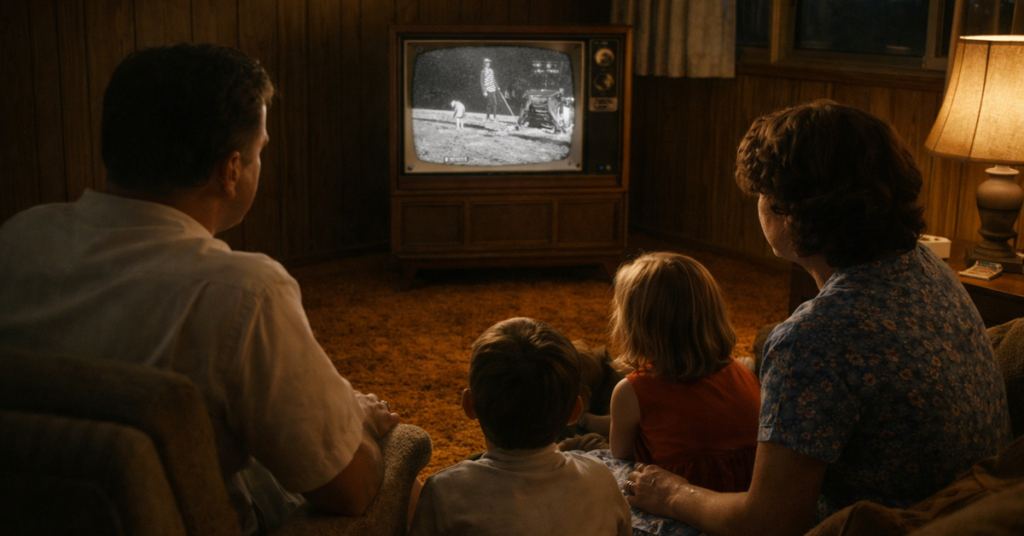
The television was small. Maybe 19 inches if your family was lucky. The picture flickered in fuzzy black and white. And yet, on that July night in 1969, nothing else in the world mattered except what was happening on that tiny screen.
You probably remember exactly where you were. The couch in your living room. Grandma’s house with all the cousins packed in like sardines. Maybe you watched through a neighbor’s window because they had the better TV. It didn’t matter where you sat. What mattered was that you were about to see something no human being had ever witnessed before.
Neil Armstrong was about to step onto the moon. And your whole world was about to change forever.
The Weeks Before Liftoff
The anticipation had been building for days. Weeks, really. Your local newspaper ran front page stories every single morning. Walter Cronkite seemed to be on television constantly, explaining trajectories and lunar modules in that calm, reassuring voice of his. You trusted Walter. Everyone trusted Walter.
At school, teachers had been preparing you all year. Science class suddenly became the most exciting period of the day. You learned about rocket fuel and gravity and the cold vacuum of space. Some kids built model rockets in their backyards. Others drew pictures of astronauts and taped them to their bedroom walls.
The grocery store had Apollo 11 displays near the checkout. There were commemorative glasses at the gas station. Life magazine published special editions that your mom kept on the coffee table. America was going to the moon, and everyone wanted a piece of history.
Your dad probably explained the mission at dinner. He’d point up at the night sky and say something like, “In just a few days, there’s gonna be Americans walking around up there.” It seemed impossible. The moon was so far away. So unreachable. And yet three brave men were going to make the journey.
July 20, 1969
That Sunday started like any other summer day. Church in the morning for many families. A big lunch. Maybe some time outside riding bikes or playing with the neighbors. But everyone knew what was coming that evening. This was the day.
As the afternoon wore on, families started gathering around their television sets. Some people moved the TV to the living room for a better view. Others dragged kitchen chairs in so everyone could see. The really prepared folks had snacks ready. Popcorn. Chips. Cold bottles of soda.
The networks had been covering the mission non-stop, but as evening approached, the tension grew. Apollo 11 was in lunar orbit. The Eagle module was about to separate. Neil Armstrong and Buzz Aldrin were going to attempt something incredibly dangerous. Something that had never been done.
You could feel it in the room. Your parents sat straighter. Your siblings got quiet. Even the dog seemed to sense something important was happening. The usual noise of a summer evening faded away as families across America focused on those grainy images coming from 238,000 miles away.
Those Famous Words
The landing itself was nerve-wracking. Mission control in Houston called out numbers. Fuel was running low. The landing site had boulders everywhere. Armstrong had to take manual control and find a safer spot. For a few terrifying minutes, nobody knew if they would make it.
Then came the words everyone had been waiting for. “Houston, Tranquility Base here. The Eagle has landed.”
Your living room probably erupted. Your mom might have cried. Your dad might have jumped out of his chair. Neighbors shouted through open windows. Car horns honked up and down the street. They had done it. Americans had landed on the moon.
But the night wasn’t over yet.
The actual moonwalk wasn’t scheduled until later. Much later. Past bedtime for most kids. But there was no way parents were sending anyone to bed that night. Rules didn’t apply when history was being made.
The hours crawled by. Armstrong and Aldrin had work to do inside the module. Checks to complete. Equipment to prepare. You probably dozed off on the couch at some point. Woke up to your mom shaking your shoulder. “It’s happening. Wake up. He’s coming out.”
And then you saw it. A ghostly figure in a bulky white suit climbing down a ladder. The image was blurry and strange. It almost looked like a dream. Armstrong reached the bottom rung and paused.
“That’s one small step for man, one giant leap for mankind.”
The whole neighborhood heard those words at the same moment. Through open windows on that warm July night, you could hear television sets echoing from every house on the block. Someone down the street cheered. A firecracker went off somewhere. America was on the moon.
What It Meant to Be Young That Night
If you were a kid watching the moonwalk, something shifted inside you that night. The impossible had become possible. Adults had always said you could be anything you wanted when you grew up. But this was proof.
Suddenly, being an astronaut didn’t seem like a silly dream. Science fiction had become science fact. If people could walk on the moon, what else could happen? Maybe you really could do anything.
The next morning, everything looked different somehow. The moon was still up there in the pale blue sky. But now it wasn’t just a distant light. It was a place. A place where human footprints marked the dust. A place where an American flag stood perfectly still in the airless silence.
Your cereal box probably had an Apollo 11 picture on it. The newspaper had photos covering the entire front page. Kids in the neighborhood spent the day playing astronaut. Someone always wanted to be Neil Armstrong. Someone had to be Buzz Aldrin. Nobody wanted to be Michael Collins, the astronaut who stayed in orbit and never got to walk on the surface.
The Ripple Effects
The moon landing changed more than just one night. It changed the way an entire generation saw the world.
Teachers started talking about careers in science and engineering. Parents encouraged kids to study math. Telescopes became popular birthday gifts. Space became cool in a way it had never been before.
The music of the time picked up on it too. David Bowie released “Space Oddity” right around the launch. Elton John would later sing about “Rocket Man.” The future suddenly seemed full of possibilities.
And the technology. Everything NASA developed for the Apollo program started showing up in regular life. Those early computer systems. New materials and fabrics. Medical advances. The pocket calculator you would use in high school a few years later owed a debt to the space program.
For your parents and grandparents, the moon landing was something else entirely. They had lived through the Depression. World War II. The Cold War tensions that made everyone afraid of nuclear bombs. The moon landing gave them hope. It proved that America could still accomplish great things when everyone worked together.
A Night You Never Forgot
More than fifty years have passed since that July evening. A lot has changed. The television sets got bigger and the pictures got clearer. Men walked on the moon five more times. Eventually, the Apollo program ended and people stopped making those incredible journeys.
But you never forgot where you were that night.
The way the room felt with your whole family gathered around. The scratch of the old couch cushions against your legs. The taste of whatever snack your mom had put out. The sound of your dad whistling softly when Armstrong made that first step. The feeling that anything was possible.
That night taught you that human beings could do remarkable things. That dreams worth chasing were worth the risk. That sometimes, the whole world could come together and watch something beautiful happen.
The moon still hangs in the sky every night. It still glows silver against the darkness. But for those of us who watched that grainy footage in 1969, it will always be more than just a light in the sky.
It will always be the place where we learned to believe in the impossible.