
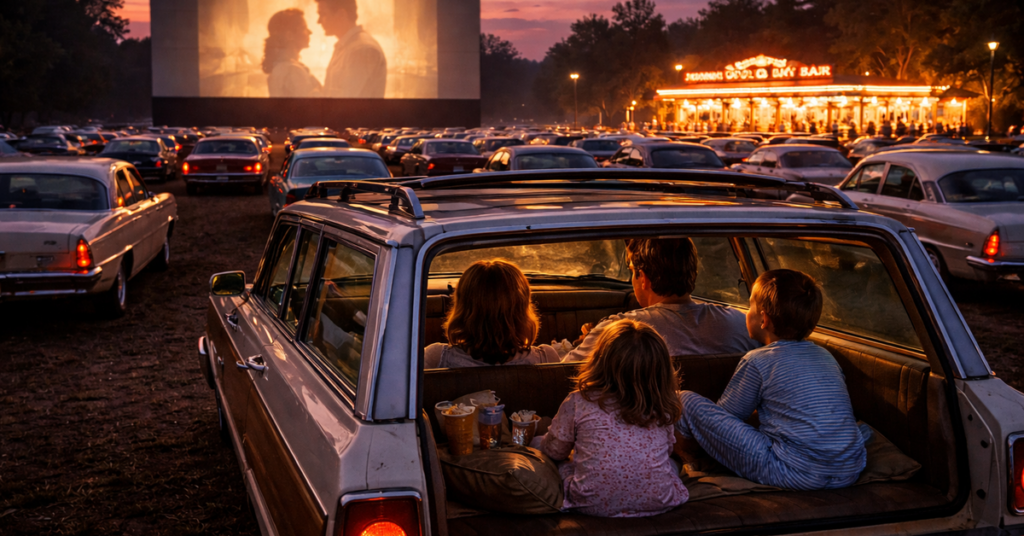
The sun is sinking low, painting the sky orange and pink as your family pulls into the gravel lot. Dad eases the station wagon over the little hill by the entrance, and suddenly there it is. That massive white screen rising up against the evening sky like a movie star waiting to perform. You can already smell the popcorn drifting from the snack bar. Your little brother is bouncing in the backseat, and Mom is unpacking the blankets she brought from home. This is going to be a good night.
If you grew up in the 1950s, 1960s, or 1970s, the drive-in movie theater wasn’t just a place to watch a film. It was a destination. An experience. A whole evening of adventure wrapped up in one magical location.
Finding the Perfect Spot
The drive-in veterans knew the game. You didn’t just park anywhere. You studied the lot like a general planning a battle.
Park too close and you’d crane your neck all night. Park too far back and you’d squint at the screen. The sweet spot was somewhere in the middle, slightly off-center, where the speaker pole lined up perfectly with the driver’s window.
Dad always had opinions about this. He’d cruise slowly through the rows, evaluating options, while the rest of the family offered suggestions that he’d politely ignore. Sometimes he’d spot a space, start to pull in, then shake his head and keep driving. The perfect spot was out there somewhere.
Once parked, the real settling in began. Pillows got arranged. Blankets got spread out. Kids got warned about staying out of the way while Dad hooked that heavy metal speaker onto the window. The speaker crackled to life with tinny music from the pre-show entertainment, and the anticipation started building.
Some families backed their station wagons in and opened the tailgate. Kids would pile into sleeping bags in the back, staring up at the stars until the movie started. Those rear-facing seats in the back of the wagon suddenly became the best seats in the house.
The Snack Bar Pilgrimage
No drive-in experience was complete without a trip to the snack bar. That little building glowing in the middle of the lot was like a beacon calling to every kid in attendance.
The snack bar had its own special smell. Popcorn popping in that bright yellow machine. Hot dogs rotating endlessly on those metal rollers. The sweet stickiness of snow cones and the sizzle of burgers on the grill. Walking through those doors felt like entering a wonderland of junk food possibilities.
Prices seemed outrageous to parents but perfectly reasonable to kids who had no concept of money. A box of popcorn the size of your head. A paper boat filled with fries. Those little round hamburgers that somehow tasted better than any burger at home. And always, always, something to drink that would guarantee a bathroom trip right during the best part of the movie.
The walk to the snack bar was an adventure in itself. You’d weave between parked cars, careful not to trip on speaker cords stretched across the gravel. Other kids were making the same journey, and you’d nod at them like fellow travelers on an important mission. The ground was uneven, and the light from the screen cast strange shadows that made everything feel a little mysterious.
Coming back with your arms full of snacks felt like a victory march. You’d navigate carefully back to your car, trying not to spill anything, already planning which treat you’d eat first.
When the Screen Came Alive
That moment when the projector flickered on never got old. First came the countdown. Those numbers getting smaller while everyone settled in and the noise dropped to a hush. Then the previews, which were almost as exciting as the main feature because they promised more movie nights to come.
The picture quality was never perfect. Sometimes the image would shake. Sometimes it would go out of focus for a minute before someone in the projection booth fixed it. On windy nights, the screen itself would flutter and make the actors look like they were dancing in a fun house mirror.
None of that mattered.
You weren’t comparing it to a movie palace downtown with perfect projection and velvet seats. You were in your own little world, surrounded by family, watching a story unfold on a screen as big as a house.
The sound coming through that speaker was tinny and hollow. If you turned it up loud enough to hear clearly, it would buzz and distort. If you kept it low, you’d miss half the dialogue. Everyone developed their own technique for speaker adjustment. Some people brought transistor radios to pick up the simulcast on FM.
But the imperfection was part of the charm. The drive-in wasn’t about technical excellence. It was about the feeling. The togetherness. The sense that you were part of something special happening under the open sky.
Pajamas, Pillows, and Passing Out
For kids, the drive-in had a secret second purpose. It was the one place where you could wear pajamas in public.
Smart parents knew the routine. Bath time before leaving the house. Pajamas on. Pillows and blankets loaded in the car. The plan was simple. Watch the movie, then carry sleeping kids straight to bed when you got home.
The first feature was always exciting enough to keep everyone awake. But by the time the second movie started, eyes were getting heavy. You’d fight it as long as you could. You’d shift positions, ask for more snacks, try to stay focused on the screen. But eventually, the combination of fresh air, a full belly, and a cozy blanket would win.
Waking up the next morning in your own bed felt like magic. How did you get there? You barely remembered the car ride home. The drive-in had worked its sleepy spell once again.
Parents probably treasured those quiet drives home. Kids zonked out in the backseat. The road empty except for other families heading home from the same movie. A peaceful end to a perfect evening.
The Teenage Years Changed Everything
The drive-in took on a whole different meaning once you got your driver’s license.
Suddenly it wasn’t about family movie night anymore. It was about taking a date somewhere dark and private. It was about borrowing Dad’s car and feeling grown up. It was about the back row, where the speaker light was dim and nobody could really see what you were doing.
Plenty of jokes got made about what really happened in those back row cars. Parents pretended not to know. Teenagers pretended to be interested in the movie. Everyone maintained the polite fiction that drive-ins were purely about cinema.
The truth was somewhere in the middle. Some nights you actually watched the movie. Some nights the movie was just background noise. Most nights were a combination of both. You’d tune in for the exciting parts and tune out when things got slow on screen.
Double features were perfect for this. Watch the first movie. Get distracted during the second. Tell your parents the whole evening was very educational and the films were excellent.
The drive-in gave teenagers something precious. A place that wasn’t home, wasn’t school, wasn’t supervised by adults with clipboards. A place where you could be yourself, with your friends or your date, and feel like you were getting away with something even when you weren’t doing anything wrong.
Those Intermission Commercials
Ten minutes till showtime! Let’s all go to the lobby!
If you can hear those words in your head right now, complete with the bouncing hot dog and dancing popcorn box, you understand a special part of drive-in magic.
The intermission commercials were corny beyond belief. They featured animated snacks with big smiles and skinny legs, marching toward the snack bar like a tiny food parade. The jingle was catchy in that annoying way that meant you’d be humming it for days afterward.
But those silly cartoons served a real purpose. They reminded everyone to visit the snack bar, sure. But they also created a shared experience. Every drive-in in America was showing the same goofy animation. Every kid was watching the same dancing candy bars.
There was something comforting about that. You knew that families in California and Florida and Kansas and Maine were all seeing exactly what you were seeing. The drive-in connected people across the whole country through shared silliness.
When the Lights Went Dark for Good
Drive-ins started closing in the 1980s and never really stopped. Land got too valuable. Multiplexes offered more showtimes. VCRs let people watch movies at home. One by one, the big screens went dark.
Driving past a closed drive-in today is a strange feeling. The screen still stands sometimes, weathered and gray. The snack bar building sits empty. Weeds grow through the gravel where hundreds of cars used to park.
But here’s the thing about the drive-in. It never really disappeared. Not completely.
Some drive-ins survived. They adapted. They showed new movies and hosted special events. A new generation discovered what all the fuss was about.
More importantly, the memories survived. The feeling of that gravel crunching under tires. The smell of that popcorn. The way the sky looked with stars above and a movie glowing below. Those things live on in everyone who experienced them.
The drive-in wasn’t just a place to watch movies. It was a place to be together. To share something as a family. To grow up and fall in love and feel like the whole world was spread out in front of you, as big and bright as that screen against the summer sky.