
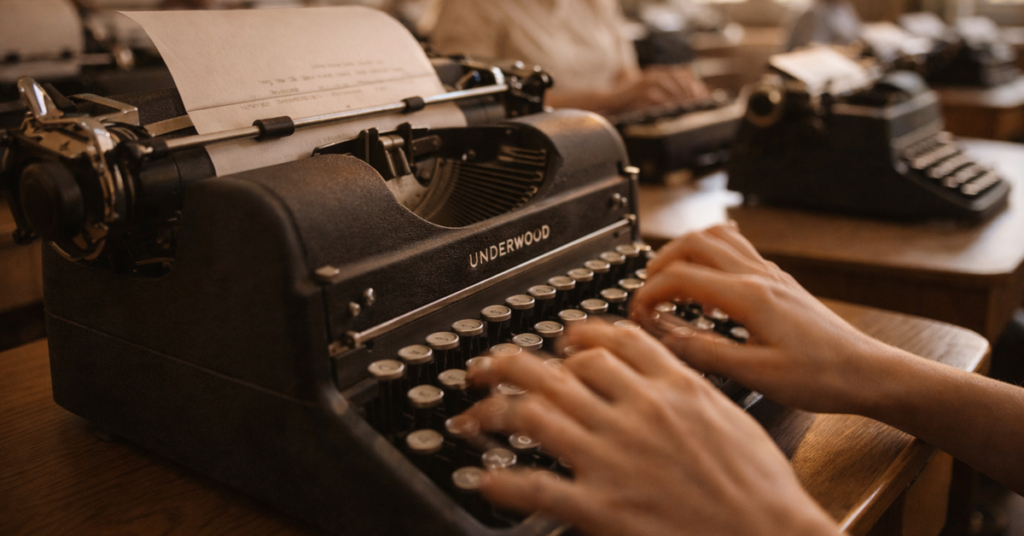
The smell hit you before anything else. That distinctive mix of ink ribbon, machine oil, and the slightly metallic tang of the keys. You’d walk into typing class and feel your stomach do a little flip. Rows of black Underwoods or Royal typewriters sat waiting on wooden desks like patient soldiers. Your fingers would soon ache from pressing those stiff keys, but somehow that pain became a badge of honor.
Learning to type on a manual typewriter was a rite of passage for millions of us. It was frustrating, demanding, and occasionally brought us to tears. It also gave us a skill that would serve us for the rest of our lives. And the sound of those keys hammering against paper? That clackety-clack rhythm still echoes in our memories like a familiar song.
The Typing Classroom Experience
Walk through the door of any high school typing room in the 1960s and you’d see the same scene across America. Thirty students sat at identical desks, fingers hovering over identical keyboards, eyes glued to identical exercise books propped up on metal stands. The teacher stood at the front with a wooden pointer and a no-nonsense attitude.
Most typing teachers were women, and they ran their classrooms with military precision. Mrs. Patterson at Jefferson High wore her hair in a tight bun and walked the aisles like a drill sergeant. She’d spot a student sneaking a peek at the keyboard from twenty feet away. “Eyes on your book, Mr. Johnson!” she’d bark, and everyone in the room would snap their heads forward.
The room itself felt almost sacred in its seriousness. Large charts showing the keyboard layout hung on every wall. Posters reminded you about proper posture. Some teachers covered the keyboards with cardboard shields so you couldn’t cheat and look down. Others put little boxes over your hands. The message was clear. You would learn to touch type the right way or not at all.
The desks were spaced far enough apart that you couldn’t see your neighbor’s paper. Not that you had time to look. The teacher would call out letters and words at a steady pace while a metronome or recorded tape kept time. “A-S-D-F, space, J-K-L-semicolon, return!” The rhythm became hypnotic after a while.
Those First Painful Weeks
Nobody forgets the shock of pressing a manual typewriter key for the first time. These weren’t the featherlight computer keyboards of today. You had to push hard enough to make a metal arm swing up and strike the paper through an inked ribbon. Weak pinkies failed completely. The letter “a” became your enemy because it required your weakest finger to do serious work.
The first week left your hands aching like you’d been doing manual labor. Which, in a way, you had. Your fingers would cramp up halfway through class. Some kids developed blisters on their fingertips from the key edges. You’d go home and try to do homework, but your hands protested every pencil stroke.
Home row became burned into your brain. A-S-D-F on the left. J-K-L and semicolon on the right. Your index fingers rested on F and J, which had little bumps or raised marks so you could find them without looking. You’d dream about home row. You’d tap the pattern on your desk during math class. Your fingers moved in those patterns while you watched television.
The reach to other keys felt impossible at first. How were you supposed to hit the “p” without moving your whole hand? The “z” key seemed miles away. And that return lever on the right side of the carriage? You had to smack it with real force to send the carriage flying back to start a new line. The ding of the margin bell and the satisfying whoosh of the carriage return became the soundtrack of progress.
The Terror of Typing Tests
Nothing made your palms sweat quite like the words “timed typing test.” The teacher would announce it, and the room would fill with quiet groans. These tests measured your speed in words per minute and penalized you brutally for every mistake.
The standard goal was thirty words per minute with no errors for a passing grade. Forty words per minute got you a B. Fifty or above earned an A and the admiration of your classmates. Some natural talents flew along at sixty or seventy words per minute, their typewriters creating a continuous machine-gun rattle.
But here’s what made it truly terrifying. Errors counted against you. Every mistake subtracted five words from your total count. So if you typed fifty words but made four errors, you actually scored thirty. This made accuracy just as important as speed. Sometimes more important.
The test would begin with complete silence except for the teacher’s stopwatch click. Then the room exploded into noise as thirty typewriters hammered away simultaneously. The sound was incredible. A thunderous clatter of keys, carriage returns dinging like tiny bells, and the occasional muttered curse when someone hit two keys at once and jammed them together.
Oh, those key jams. Two metal type bars would swing up at the same moment and get tangled in mid-air like fighting stags locking antlers. You’d have to reach in and manually separate them, losing precious seconds. Your fingers would come away smudged with ink, and your test paper would have an ugly blob where the accident happened.
Mistakes Were Permanent
Young people today have no concept of what it meant to make a typing mistake before correction tape and delete keys existed. When you hit the wrong key on a manual typewriter, that error was there forever. The letter had been physically stamped into the paper with ink. You couldn’t wish it away.
The first solution was the eraser. Not a regular pencil eraser, but a special typing eraser. It was round and about the size of a silver dollar, made of gritty rubber that could wear through paper if you rubbed too hard. You’d spin the carriage knob to move the paper up, erase like your life depended on it, blow away the pink eraser dust, roll the paper back down, and try again. The erased spot always looked suspicious. Teachers could spot an erasure from across the room.
Correction fluid came along eventually, and it felt like a miracle. Liquid Paper and its competitors let you paint over mistakes with a little brush. But you had to wait for it to dry completely before typing over it. Impatient students who typed too soon ended up with keys gummed up with white goop. The smell of that correction fluid still brings back vivid memories. Slightly chemical. A bit like nail polish.
The best strategy was simply not making mistakes in the first place. This created intense focus during typing sessions. Your brain had to process each letter, confirm it was correct, and command your finger to strike with the right amount of force. All of this happened in a split second, repeated thousands of times per class period. No wonder we came home exhausted.
The Physical Demands of Manual Machines
A manual typewriter was a serious piece of machinery. Those things weighed twenty pounds or more. Moving one from desk to desk required real strength. Carrying your own portable typewriter to and from school meant lugging something heavier than most textbooks combined.
The Royal, the Underwood, the Remington, and the Smith Corona were the common brands in schools. Each had its own personality. Some teachers swore the Royals had lighter key action. Others preferred the solid feel of an Underwood. Students developed loyalty to particular machines and would rush to class early to claim their favorite.
The mechanical workings inside fascinated curious minds. When you pressed a key, a complex series of levers and linkages made a type bar swing up and strike the ribbon against the paper. The ribbon was a long loop of fabric soaked in ink, and it advanced slightly with each keystroke. When one section got too faint, you’d move a little lever to shift to a fresh part of the ribbon or flip it to use the other half.
Changing a ribbon was its own adventure. You’d end up with ink on your fingers, your clothes, and somehow your face. The ribbon came wound on two small spools that had to be threaded through the machine just right. Do it wrong and the ribbon would bunch up or refuse to advance. Every typing student learned to perform this maintenance ritual whether they wanted to or not.
More Than Just a Skill
What typing class really taught us went far beyond hitting the right keys. It taught patience. You couldn’t rush through without making mistakes. It taught precision. Sloppy work was immediately visible on the page. It taught persistence. Those aching fingers had to keep going until the bell rang.
The discipline transferred to everything else we did. Students who mastered typing developed a kind of mental focus that served them in other subjects. The concentration required to type accurately for forty-five minutes straight trained the brain in ways we didn’t fully appreciate at the time.
For many girls in the 1950s and 1960s, typing class was presented as essential job preparation. The message was sometimes limiting. You’ll need this skill to be a secretary. But the skill itself proved invaluable regardless of career path. Lawyers, journalists, writers, business owners, and people in every profession benefited from being able to type without hunting and pecking.
And there was genuine pride in mastery. Getting that first certificate for forty words per minute felt like winning a medal. Watching your fingers fly across the keyboard without a single glance downward was almost magical. You had trained your body to do something complex without conscious thought. Not everyone could say that.
A Sound We’ll Never Forget
Close your eyes and you can probably still hear it. The rapid-fire clacking of keys striking paper. The ding of the margin bell warning you the line was ending. The whoosh and thunk of the carriage return. The metallic ping when two keys jammed together. The steady rhythm of an entire classroom typing in near-unison.
That sound meant business was getting done. It meant words were becoming real, physical things on paper. It meant we were learning something useful, something that would matter for decades to come.
The manual typewriter is mostly a museum piece now. Our grandchildren will never know the satisfaction of a perfectly typed page or the frustration of making an error on the last line of a document. They’ll never experience the physical workout of typing a ten-page term paper or the careful maintenance of a beloved machine.
But those of us who learned on manual typewriters carry something special. We know what it means to work for every single letter. We understand that words have weight, both figuratively and literally. And somewhere deep in our muscle memory, our fingers still remember exactly where to find home row.