
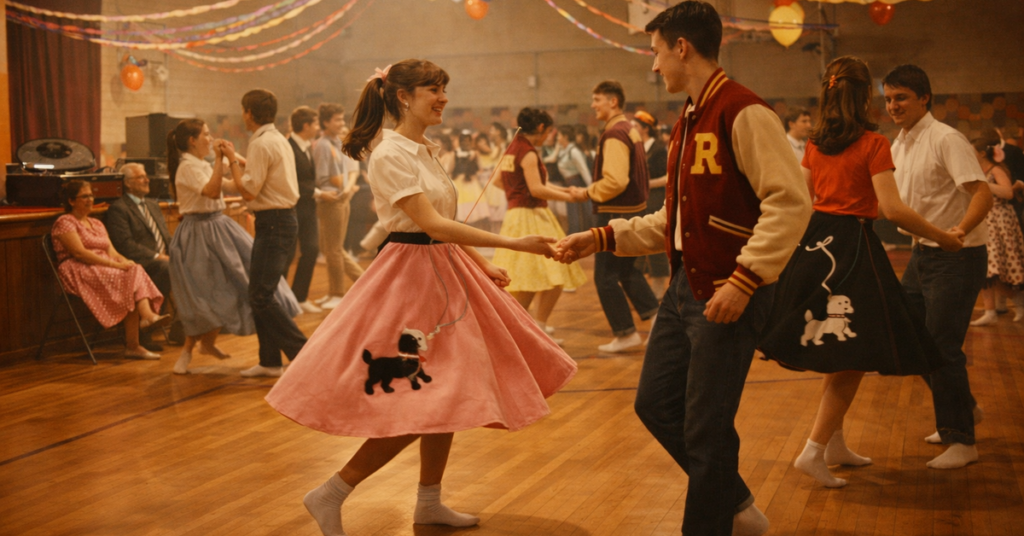
The gymnasium floor was slippery beneath your socks. The bleachers were pushed back against the walls. And somewhere between the basketball hoops, a record player was about to change your life forever.
If you grew up in the 1950s or 1960s, you know exactly what I’m talking about. The school sock hop was more than just a dance. It was a rite of passage. It was where you learned things they never taught in any classroom.
Taking Off Your Shoes and Finding Your Courage
You probably remember that moment of walking through the gymnasium doors. The lights were dimmer than usual. Crepe paper streamers hung from the rafters in your school colors. And right there at the entrance sat a cardboard box where you had to drop off your shoes.
The whole point of the sock hop was protecting that precious gym floor. No street shoes allowed. So there you stood in your bobby socks or your best argyle pair. Suddenly you felt a little vulnerable. A little exposed. And completely terrified that someone might notice the tiny hole near your big toe.
The sock hop started in the late 1940s and really took off through the 1950s. Schools loved them because they were cheap to organize. Parents loved them because they were supervised. And we loved them because they were the only place where holding hands with someone was actually encouraged by adults.
That gymnasium smelled like floor wax and nervous sweat. Maybe a hint of Clearasil and too much Aqua Velva. The combination was unforgettable.
Standing Against the Wall Like It Was Your Job
Here’s the truth nobody talks about. Most of us spent the first hour of every sock hop plastered against the gymnasium wall. The boys clustered on one side. The girls huddled on the other. And about fifteen feet of empty floor stretched between us like the Grand Canyon.
The chaperones stood near the refreshment table. Usually it was your math teacher and somebody’s mother. They watched us with those knowing smiles that made everything worse. You could almost hear them thinking about how we would eventually figure this out.
The music played. Chubby Checker begged everyone to do The Twist. And still, nobody moved.
Finally, someone brave would venture onto the floor. Maybe it was the class clown who didn’t care what anyone thought. Or the couple who had been “going steady” since September. Once a few people started dancing, the invisible wall began to crack. Slowly, painfully, wonderfully, the floor would fill.
Getting out there took everything you had. Your palms were sweating. Your heart was pounding. And you were absolutely certain that everyone in the entire school was watching you specifically.
Learning the Dances from Anyone Who Would Teach You
Nobody handed us a instruction manual for The Twist. We learned by watching each other and hoping for the best.
Your older sister might have shown you the basic moves in the living room. Your cousin who lived in the city always knew the latest steps before anyone else. And American Bandstand on television was like free dance school every afternoon.
Dick Clark introduced us to dances we had never imagined. The Mashed Potato. The Pony. The Watusi. The Swim. Each one had its own moves that seemed impossible at first and became second nature after enough practice in front of your bedroom mirror.
The fast dances were actually easier in some ways. You could kind of fake your way through if you just kept moving and smiled a lot. The Twist was genius because everyone faced the same direction and nobody had to touch anybody else. It was perfect for those of us who were still figuring out what to do with our hands.
But the slow dances. Oh, the slow dances were something else entirely.
The Slow Dance Changed Everything
When the opening notes of a slow song started, the entire atmosphere shifted. You could feel it like a change in air pressure. This was the moment that mattered.
The DJ or whoever was running the record player might put on “Earth Angel” or “In the Still of the Night.” Maybe Elvis singing “Love Me Tender.” And suddenly the rules were different.
You had to actually ask someone to dance. Face to face. Using words. The walk across that gymnasium floor felt about three miles long.
The boys who got rejected had to walk all the way back to their side of the room while everyone watched. The girls who wanted to dance had to wait and hope. And somewhere in the middle, awkward magic happened.
The slow dance position was its own kind of education. Where exactly did your hands go? How close was too close? What were you supposed to do with your head? If your cheek accidentally touched her hair, did that count as something?
Chaperones patrolled the floor with eagle eyes. They carried rulers and were not afraid to use them. “Leave room for the Holy Ghost” was something Catholic school kids heard regularly. That meant keep daylight visible between your bodies.
Still, those three minutes of swaying back and forth with someone you liked felt like the most grown-up experience of your entire life so far.
The Music That Became the Soundtrack of Our Youth
The songs they played at those sock hops are still playing in your head. You can probably hear them right now just reading this.
Little Richard screaming about Tutti Frutti. Buddy Holly hiccuping through “Peggy Sue.” The Everly Brothers harmonizing on “All I Have to Do Is Dream.” Every song from those years carries the ghost of a gymnasium.
The record player sat on a folding table near the stage. Someone’s older brother or the shop teacher usually controlled the music. Requests were shouted from the crowd. Sometimes honored and sometimes ignored.
When the Supremes or The Beatles or The Beach Boys came through those speakers, something electric happened. These weren’t just songs. They were declarations. They told us who we were and who we wanted to become.
And the last song of the night was always meaningful. The DJ would announce it was coming. Couples would find each other quickly. And if you hadn’t worked up the courage to ask anyone all evening, this was your final chance.
The Walk Home and the Replaying of Every Moment
The sock hop usually ended around 9 or 10 PM. You retrieved your shoes from that cardboard box. Your socks might be damp or dusty or both. And then came the walk home.
If you were lucky, you walked with friends who wanted to analyze every single thing that happened. Who danced with who. What song was playing when Tommy finally talked to Karen. Whether that look from across the room meant anything or nothing.
You replayed your own moments over and over. The time you almost asked someone to dance but didn’t. The time you actually did and they said yes. The way the gymnasium lights made everyone look a little softer and more beautiful than they did during regular school hours.
By the time you got home, you had already started planning what you would do differently at the next sock hop. Maybe next time you would be braver. Maybe next time you would learn that new dance everyone was doing. Maybe next time you would actually talk to the person you had been watching all night.
More Than Just Dancing
Looking back now, those sock hops taught us things we didn’t even realize we were learning.
We learned how to handle rejection and try again. We learned that being brave for three minutes could lead to something wonderful. We learned that everyone else was just as scared and uncertain as we were.
We learned that music could make ordinary moments feel extraordinary. We learned that a gymnasium could become a magical place with nothing more than crepe paper and a record player.
Most importantly, we learned how to take those first clumsy steps toward connection with other people. The sock hop was practice for everything that came later. First dates. First loves. First heartbreaks.
Your socks would be stretched out and slide around in your shoes the whole next day. That was the physical proof that the previous night had really happened. That you had really stood on that floor. That you had really danced. That you had really lived something worth remembering.
The gymnasium is probably different now. Maybe it’s been renovated or torn down. But somewhere in your memory, the streamers are still hanging. The record is still spinning. And you’re still standing there in your socks. Young and nervous and absolutely certain that whatever happened next was going to be the most important thing in the world.